
 EN
 AR
 BG
 HR
 CS
 DA
 NL
 FI
 FR
 DE
 EL
 HI
 IT
 JA
 KO
 NO
 PL
 PT
 RO
 RU
 ES
 SV
 CA
 TL
 IW
 ID
 LV
 LT
 SK
 SL
 UK
 ET
 GL
 HU
 MT
 TH
 TR
 FA
 MS
 GA
Avoid the "Cheap Light" Trap: Maintenance & Decay
2026
If you have ever stepped onto a sports court using traditional halogen lighting after dark, the scene is likely familiar: a dim, yellowish glow pools beneath the basketball hoop while the three-point line fades into shadow; on the soccer pitch, towering light masts cast a harsh white glare that somehow leaves vision feeling blurred. Then there is the headache of operating costs: over 80% of the electrical energy is converted into heat rather than light, and an average lifespan of just 2,000 to 4,000 hours entails frequent, costly maintenance requiring work at heights. Furthermore, significant light degradation causes illumination levels to drop year by year, often to the point where the facility fails to meet professional certification standards.
This is not merely a matter of visual experience or cost. Modern competitive sports demand millisecond reaction times and precise muscle memory—capabilities that rely fundamentally on clear visibility. FIFA and national sports associations enforce rigorous standards regarding illumination levels, uniformity, glare control, and color rendering indices; against these strict benchmarks, traditional halogen lighting falls woefully short.
Today, a quiet "lighting revolution" is unfolding in sports venues across the globe. From community basketball courts to professional soccer stadiums, the transition from halogen to LED lighting is no longer a question of *if*, but an inevitable trend of *when*. This shift represents not only technological evolution and a recalculation of operating expenses but also a necessary step toward the professionalization and standardization of sports facilities.
1.Saving on electricity costs
From the perspective of saving on electricity costs, the case for replacing traditional halogen stadium lights with LEDs is straightforward: halogen lights suffer from extremely low photoelectric conversion efficiency, with over 80% of electrical energy wasted as heat and less than 20% actually converted into light. Consequently, to illuminate a sports field to the same level of brightness, halogen lights consume several times more electricity than LEDs.
Furthermore, LED fixtures boast a lifespan exceeding 50,000 hours—far surpassing the 2,000 to 4,000-hour lifespan of halogen lights—thereby drastically reducing labor and material costs associated with replacements. Thus, viewed through the most immediate lens of electricity savings, replacing traditional halogen lights with LEDs is not merely a trend, but a financially sound decision with clear, tangible returns.
2.Saving on maintenance costs
From a maintenance cost perspective, the drawbacks of traditional halogen lamps are equally significant. With an average lifespan of only 2,000 to 4,000 hours, high-usage sports venues often require high-altitude replacement operations every few months. Each replacement entails not only the cost of the lamps themselves but also expenses for crane rentals, specialized labor, and revenue losses due to lighting downtime—hidden costs that frequently far exceed the price of the fixtures.
In contrast, LED sports lights typically boast a lifespan exceeding 50,000 hours—ten to twenty times that of halogen lamps. This means that, given the same usage frequency, LED fixtures may not require replacement for years or even over a decade, drastically reducing maintenance intervals. For high-mast sports lighting, eliminating the need for high-altitude maintenance translates into tangible cost savings. Therefore, when evaluating maintenance costs, replacing traditional halogen lamps with LEDs not only lowers direct expenditures but also minimizes operational uncertainties and safety risks.
3.HD Live Streaming and Visual Experience
Traditional lighting fixtures not only cast a yellowish hue but also cause significant visual fatigue and noticeable flickering.
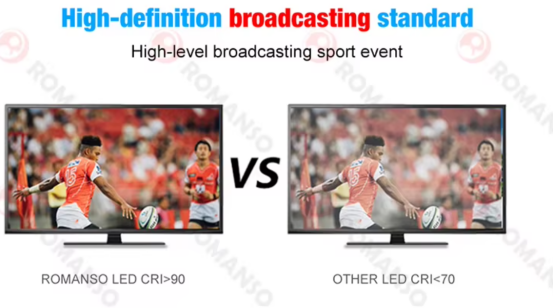
- Color Rendering Index (CRI): LEDs provide color rendering close to natural light (CRI > 80/90), enabling players to more accurately judge ball speed and positioning, while offering spectators a more vivid viewing experience.
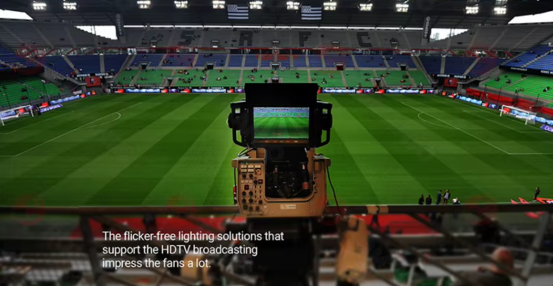
- Flicker-free technology: 4K broadcasting and slow-motion replays are standard features in modern stadiums. Traditional lighting produces visible flickering black bands during slow-motion playback, whereas professional-grade LED driver systems ensure flawless video footage.
- Instant-on capability: Metal-halide lamps require a 10–15 minute warm-up period and cannot be restarted immediately after an unexpected power outage. LEDs offer instant switching, providing a decisive advantage during sudden power failures or transitions between events.
4.Reduction of light pollution
When considering the reduction of light pollution, the issues associated with traditional halogen lamps cannot be overlooked. Halogen lamps typically emit light omnidirectionally, causing a significant amount of light to scatter outside the sports field; this not only wastes energy but also intrudes into nearby residential areas, creating urban light pollution that disturbs local residents. Furthermore, these lamps produce severe glare and uneven light distribution, which impairs athletes' visibility and exacerbates the problem of light spill beyond the field's boundaries.
In contrast, LED sports lights feature highly directional light emission. When combined with specialized optical lenses and shielding designs, they can project light precisely onto the playing area, drastically reducing light spill into the sky and surrounding environment. This effectively minimizes disturbances to nearby residents and prevents unnecessary skyglow. Therefore, from the perspective of mitigating light pollution, replacing traditional halogen lamps with LEDs is the logical choice for enhancing lighting quality while ensuring environmental friendliness.
From slashed electricity bills to drastically reduced maintenance needs; from the rigorous lighting standards required for professional competitions to the growing concern over light pollution in urban night skies—the replacement of traditional halogen lamps with LED stadium lights is no longer a proposition requiring debate. It represents a clear economic gain, a tangible upgrade in the user experience, and an industry evolution that aligns with technological trends and environmental principles.
Traditional halogen lamps once illuminated countless classic matches, fulfilling their historic mission. Yet, with the advent of LED technology—offering superior efficiency, durability, precision, and eco-friendliness—clinging to outdated light sources means continuing to pay high, hidden costs for obsolete technology. Whether for community courts or professional arenas, choosing LED means securing higher-quality lighting and a more sustainable operational model with lower long-term investment.
Light is the soul of a sports venue. Transforming every unit of electricity into clarity and confidence for the athletes, and ensuring every beam of light falls exactly where it belongs—this is the true value LED brings to modern sports facilities. The wave of transition is already here, and the answer is written clearly in the night sky above every stadium that has made the upgrade.


