
 EN
EN
 AR
AR
 BG
BG
 HR
HR
 CS
CS
 DA
DA
 NL
NL
 FI
FI
 FR
FR
 DE
DE
 EL
EL
 HI
HI
 IT
IT
 JA
JA
 KO
KO
 NO
NO
 PL
PL
 PT
PT
 RO
RO
 RU
RU
 ES
ES
 SV
SV
 CA
CA
 TL
TL
 IW
IW
 ID
ID
 LV
LV
 LT
LT
 SK
SK
 SL
SL
 UK
UK
 ET
ET
 GL
GL
 HU
HU
 MT
MT
 TH
TH
 TR
TR
 FA
FA
 MS
MS
 GA
GA
How to Choose Stadium Lights? From Illuminance Uniformity to RGB Ambience, a Complete Guide to Professional Sports Lighting
2026
Introduction: Why Stadium Lighting Deserves More Attention
When people watch a night football match on TV or sit in a stadium, they rarely think about the lighting system above their heads. Yet stadium lighting is one of the most important pieces of infrastructure behind every professional sports event. It affects how fairly the game is played, how safely athletes move, how clearly viewers see the action, and how much energy the venue consumes every year.
Choosing stadium lights is not simply a matter of picking the brightest product on the market. It requires an understanding of international standards, optical design, control systems, energy efficiency, and long-term reliability. This guide walks through the key factors that define professional stadium lighting—from illuminance and uniformity to anti-glare performance, RGB ambience, energy efficiency, and international certifications.
1. Why Brighter Isn't Always Better for Stadium Lights
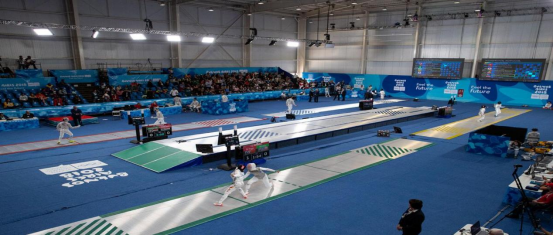
Many people assume stadium lights just need to be bright. In reality, professional sports lighting follows strict international standards. FIFA, FIBA, and IES set clear requirements for horizontal illuminance, vertical illuminance, and uniformity. For international A-level football matches, horizontal illuminance must reach 1000–1500 lx, with vertical illuminance no less than 750–1000 lx. International basketball courts require even higher levels—1500 lx or more. These figures are not arbitrary; they are the baseline for broadcast quality, athletes' visual judgment, and event compliance.
Horizontal illuminance refers to the light falling on the ground surface. It determines how well players can see the field, the lines, and the ball when it is on the ground. Vertical illuminance refers to light falling on vertical surfaces—essentially, the light that reaches the players' bodies and faces. For live broadcasts, vertical illuminance is critical because cameras capture players from the side, not from above. If vertical illuminance is too low, players appear as dark silhouettes on screen, even if the ground looks bright.
Counterintuitively, making stadium lights too bright can also cause problems. Excessive illuminance increases glare, raises energy consumption, and can even distort color reproduction on camera. It may also create uncomfortable viewing conditions for spectators. Professional lighting design aims for the right level of illuminance—not the maximum possible level.
When selecting stadium lights, buyers should not simply compare wattage or lumen output. They should ask for photometric reports that show horizontal illuminance, vertical illuminance, and uniformity values at the actual installation height and layout. A reputable supplier should be able to provide a lighting simulation based on the venue's dimensions, mounting height, and event level.
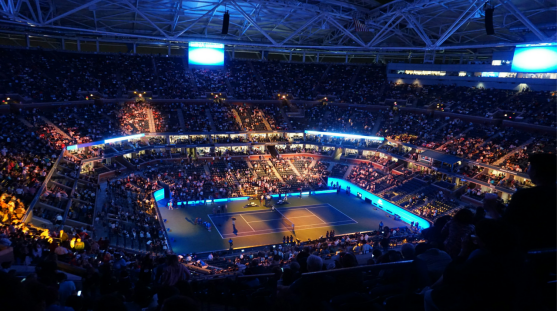
2. Uniformity: The Invisible Metric That Decides Fairness
High illuminance alone is not enough. If light is unevenly distributed, bright and dark zones appear on the field. IES specifies that the ratio of maximum to minimum illuminance (U1) should not exceed 3:1, and the ratio of average to minimum illuminance (U2) should be within 1.5:1. Research shows that uneven lighting can increase athletes' misjudgment of ball trajectory by 35%–45%, directly affecting fairness.
Imagine a football pitch where one corner is brightly lit and another is dim. Players in the dim area may misjudge the speed and direction of the ball. Goalkeepers may lose sight of a shot coming from a shadowed zone. Over the course of a match, these small disadvantages add up and can influence the final result. Uniformity is also critical for broadcast cameras. If one part of the field is much brighter than another, the camera operator must constantly adjust exposure, and viewers may see washed-out or darkened areas on screen.
Uniformity is not achieved by adding more lights. It is achieved through careful optical design and scientific layout. Professional stadium lights use precision lenses that shape the beam into a rectangular or asymmetric pattern, directing light exactly where it is needed. The lights are then arranged in a symmetrical grid, often on four corners or along the sides of the venue, so that overlapping beams fill in each other's weak spots. A good lighting simulation will show the U1 and U2 values across the entire playing surface, not just at a few sample points.
During the 2023 Asian Football Confederation (AFC) Cup qualifiers, a venue was required to rectify its lighting system because the illuminance uniformity failed to meet FIFA standards. This incident was reported by AFP at the time, demonstrating that uniformity is not a minor detail—it is a condition for hosting official events.
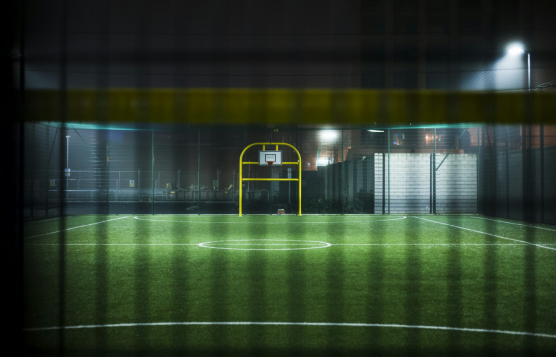
3. Anti-Glare: Protecting Athletes and Spectators
Glare is a major hazard in stadium lighting. CIE mandates that the glare rating (GR) for outdoor professional stadiums must be below 22. Studies show that venues with GR values above 22 have a 28% higher incidence of athlete injuries caused by visual distraction. Professional stadium lights use anti-glare grids, deep cavity designs, and adjustable beam angles to keep glare within safe limits. The LED stadium lights at the 2022 Qatar World Cup venues controlled GR to below 18, far exceeding CIE requirements.
Glare occurs when a light source is significantly brighter than the surrounding environment, causing discomfort or temporary visual impairment. In a stadium, glare can come directly from the light fixtures or indirectly from reflections off wet surfaces, metal structures, or even the players' equipment. For athletes, glare can be the difference between seeing the ball and losing it for a split second. For spectators, glare causes eye strain, headaches, and a less enjoyable viewing experience.
Anti-glare grids, also known as louvers, block light rays that would otherwise travel directly into the eyes of players and spectators. Deep cavity designs recess the LED light source inside the fixture housing, so the light is directed downward rather than sideways. Adjustable beam angles allow installers to aim light precisely at the field and away from sensitive areas. Some high-end fixtures also use asymmetrical optics, which shape the beam so that more light goes to the far side of the field and less to the near side.
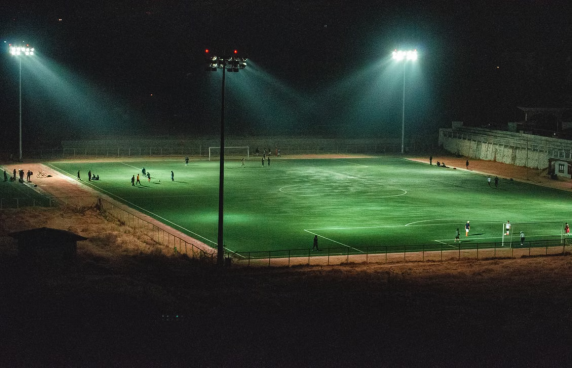
4. RGB Function: Turning Stadium Lights from Illumination into Atmosphere
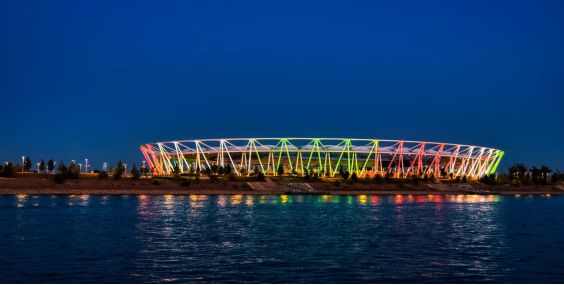
Beyond match lighting, modern stadium lights increasingly include RGB functionality. RGB (red, green, blue) mixing can produce almost any color, used for pre-game warm-ups, goal celebrations, brand events, and concert modes. For example, after a goal, the entire stadium can instantly switch to the home team's colors, flashing in sync with music, dramatically lifting the atmosphere. RGB stadium lights typically support DMX512 control protocol, allowing dynamic gradients, chasing, and strobe effects when linked to a lighting console.
RGB lighting transforms a stadium from a functional venue into an entertainment space. Before a match, the lights can create a dramatic entrance for the teams. After a goal, they can flood the stadium in the winning team's colors. During halftime, they can run dynamic light shows synchronized with music. For sponsors and brand events, RGB lighting can project brand colors and logos onto the field or the stands. This flexibility is increasingly important for modern venues that host more than just sports.
Most professional RGB stadium lights support DMX512, a widely used control protocol in the entertainment and architectural lighting industry. DMX512 allows each fixture to be addressed individually and controlled from a central lighting console. Some systems also support Art-Net or sACN, which allow lighting control over Ethernet networks.
It is important to understand that RGB functionality is usually an addition, not a replacement, for white match lighting. During official matches, the stadium must switch to high-CRI, high-illuminance white light. UEFA, for example, requires Champions League stadium lights to have a color rendering index (CRI) above 90 and a color temperature of 5000K–6500K. When purchasing RGB stadium lights, ask whether the fixture supports dual-mode operation—white light for matches and RGB for atmosphere
5. Energy Efficiency and Durability: Every Saving Counts
Traditional metal halide stadium lights have a luminous efficacy of only 60–80 lm/W, while modern LED stadium lights can reach 150–180 lm/W. U.S. Department of Energy data shows that replacing traditional stadium lights with LED can reduce energy consumption by 60%–70%. A medium-sized football stadium with 50 sets of 1000W fixtures can save tens of thousands of dollars in electricity annually. In terms of lifespan, professional LED stadium lights last 50,000 hours or more—3–5 times longer than traditional lamps—and IP65+ protection handles rain, snow, and high temperatures.
6. International Certifications: The Passport to Reliability
Professional stadium lights must pass a series of international certifications to enter the global market, including CE (EU safety), RoHS (environmental), FCC (U.S. electromagnetic compatibility), and IP rating certifications. These are not only mandatory market access requirements but also guarantees of product quality. According to IEC statistics, 80% of stadium operators prioritize certified products when purchasing lighting systems to reduce quality issues and after-sales disputes.
Summary: Good Stadium Lights Are Part of the Game Experience
From illuminance, uniformity, and anti-glare to RGB ambience, energy efficiency, and certifications, every metric of professional stadium lights affects fairness, athlete safety, broadcast quality, and operational costs. RGB functionality turns stadium lights from mere illumination into a director of atmosphere. Choose the right stadium lights, and night games truly shine.
When evaluating stadium lighting, look beyond wattage and price. Ask for photometric reports, check certifications, consider RGB and control options, and calculate long-term energy savings. A well-designed lighting system is not an expense—it is an investment in the quality of every game played under it.


