
 EN
EN
 AR
AR
 BG
BG
 HR
HR
 CS
CS
 DA
DA
 NL
NL
 FI
FI
 FR
FR
 DE
DE
 EL
EL
 HI
HI
 IT
IT
 JA
JA
 KO
KO
 NO
NO
 PL
PL
 PT
PT
 RO
RO
 RU
RU
 ES
ES
 SV
SV
 CA
CA
 TL
TL
 IW
IW
 ID
ID
 LV
LV
 LT
LT
 SK
SK
 SL
SL
 UK
UK
 ET
ET
 GL
GL
 HU
HU
 MT
MT
 TH
TH
 TR
TR
 FA
FA
 MS
MS
 GA
GA
Stadium LED Retrofit: Equivalent MH-to-LED Replacement Reusing Existing Light Poles
2026
When planning a stadium lighting upgrade, many facility owners’ first instinct is to replace all the light poles. However, the full set of costs-including pole removal, demolition of old concrete foundations, re pouring and curing of new foundations, crane mobilization, plus revenue losses from venue shutdowns-often exceeds the total purchase price of the lighting fixtures themselves.
As a result, numerous stadium retrofitting projects are put on hold. Venues are forced to keep using aging metal halide lamps, which suffer from yellowed light output, insufficient illuminance at perimeter areas, high power consumption and frequent breakdowns.
In fact, most existing light poles can be reused. A retrofit's success doesn't depend on how expensive the LED lights you buy are. Instead, it hinges on clarifying three key questions prior to construction: How to select fixtures for equivalent replacement? What mandatory specifications should LED lighting fixtures meet? What are the hidden costs in the renovation?
1.Selecting Fixture Parameters for Equivalent Replacement
Metal-halide lamps suffer severe lumen depreciation. By the mid‑point of their service life, their actual light output often drops to half of their initial factory output. A substantial gap may exist between the brightness observed on‑site by the naked eye and the rated power printed on fixture nameplates.
If LED power is converted according to the original rated power, fixtures will be over-powered, resulting in unnecessary cost waste. If power is reduced merely based on subjective on-site observations, the stadium may end up dimmer than before renovation.
Beyond lumen depreciation, the two light sources operate on fundamentally different light-emitting principles.
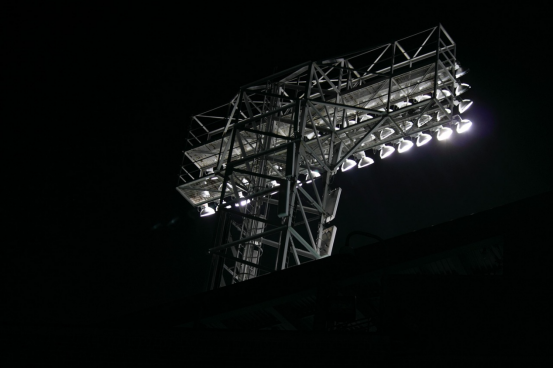
Metal-halide lamps emit light in all directions. Light is gathered by reflectors, yet losses occur during reflection. A considerable portion of light spills outside the stadium and illuminates surrounding areas.
LEDs deliver directional light, secondary light distribution is realized via lenses, so light can be precisely confined within stadium boundaries. Therefore, the input power of these two light sources offers no direct reference value for achieving identical effective on-site illuminance.
The sole valid criterion for proper fixture selection is actual on-site illuminance and illuminance uniformity, rather than the power rating of legacy fixtures.
With 19 years of experience manufacturing professional stadium lighting fixtures, our engineering team provides professional DIALux lighting simulation calculations. Just provide site dimensions, pole height, coordinates of existing lamp positions and target illuminance class, and we will deliver a complete lighting simulation report. The report specifies required lamp power, quantity, light distribution scheme and installation projection angles, and predicts the average illuminance and uniformity after retrofitting.
Conducting lighting simulation in the early stage not only ensures a professional and accurate solution, but also cuts project costs, eliminating rework or additional fixture installation caused by dim corner areas discovered only after completion.
2.Selecting Suitable LED Stadium Lights
Traditional metal-halide lamps are plagued by high power consumption, rapid lumen depreciation, poor light-control performance and high failure rates. When selecting LED replacement fixtures, you should focus on verifying the corresponding core parameters.
Take our RMS-FL-L2 stadium light as an example:
It achieves a maximum luminous efficacy of 160 lm/W, with an L70 service life exceeding 100 000 hours at 25 ℃.
The housing is made of die-cast aluminum with anti-corrosion treatment and polyester powder coating. Its operating temperature ranges from -40℃ to 50℃. The 100-277 V version comes with 4kA surge protection as standard, while 10kA and 20kA surge protection are available upon custom request. Also a 5-year warranty is provided.
In terms of electrical performance, THD<20% and power factor PF>0.9. A high power factor reduces circuit-capacity occupancy, so the existing wiring circuits of old stadiums can mostly be reused without large-scale rewiring.
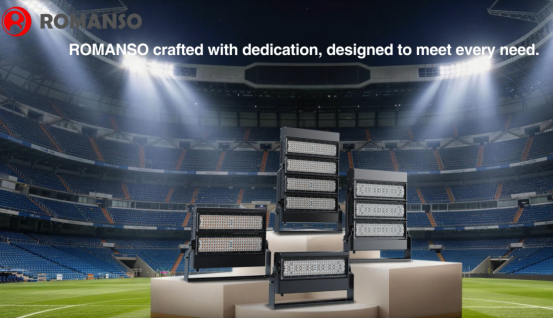
A wide selection of light-distribution options is available: 15°, 30°, 45°, 60°, 90°, and 90×145°. Narrow beam angles illuminate far‑field zones, whereas wide beam angles cover near-field areas. The 90×145° asymmetric light distribution effectively contains light spillage and mitigates light pollution to surrounding environments.
Color-temperature choices cover 3000K / 4000K / 5000K / 5700K / 6500K. For venues requiring filming or live sports broadcasting, the high CRI variant is recommended to ensure authentic, color-accurate imagery.
The product holds full-set certifications including ETL, cETL, FCC, CE, SAA and RoHS. It has been deployed at professional competition venues and was used for the 2020 UEFA in Romania as well as the 2023 FIG Trampoline Gymnastics World Championships.
3.Easily Overlooked Hidden Renovation Costs
When comparing quotations, most property owners only focus on the unit price of lighting fixtures. However, stadium renovation projects often involve dozens or even hundreds of fixtures. Ocean freight is charged based on whichever is greater: volume (CBM) or weight. Accordingly, fixture packing volume directly drives overall logistics costs. Regular-shaped square fixtures can be stacked tightly with minimal empty space inside cartons.
Another hidden cost comes from high-altitude installation. Cranes are rented on a daily basis, and working at-height personnel are paid by working hours. If fixtures arrive on-site yet the brackets prove incompatible or projection angles are hard to adjust, repeated lifting and commissioning will generate substantial extra expenses beyond the budget.
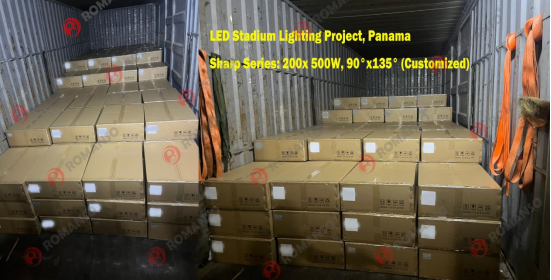
To address the above pain points, the RMS-FL-L2 has been optimized at the product-design stage.
It features a neat rectangular housing with a carton height of merely 195 mm. More units can fit into one shipping container, cutting ocean-freight logistics costs. Its lightweight design is achieved through structural and thermal-dissipation optimizations, rather than thinning the housing to compromise heat-dissipation performance. IP66 protection rating, die-cast aluminum heat-dissipation housing, and wide operating temperature range from -40℃to 50℃are all retained.
A U-bracket is supplied as standard. The pitch angle can be adjusted directly on-site for fast alignment against parameters from the simulation report. Repeated disassembly and reassembly are avoided, and custom-made brackets for different angles are unnecessary.
Returning to the opening question: Is it feasible to retrofit an old metal-halide lit stadium without replacing existing light poles?
It is definitely feasible. If you have ongoing replacement or installation projects, with any confusion or want to achieve more cost savings, please feel free to contact us.


