
 EN
 AR
 BG
 HR
 CS
 DA
 NL
 FI
 FR
 DE
 EL
 HI
 IT
 JA
 KO
 NO
 PL
 PT
 RO
 RU
 ES
 SV
 CA
 TL
 IW
 ID
 LV
 LT
 SK
 SL
 UK
 ET
 GL
 HU
 MT
 TH
 TR
 FA
 MS
 GA
How Many Light Fixtures Do I Need for My Warehouse
2026
A practical guide to warehouse lighting design, fixture selection, and quantity estimation
The number of light fixtures a warehouse needs depends on more than floor area. Mounting height, target illuminance, fixture lumen output, beam angle, rack layout, aisle width, surface reflectance, and lighting controls all affect the final design. The right solution should provide sufficient and uniform light while reducing energy use, maintenance work, glare, and unnecessary operating costs.
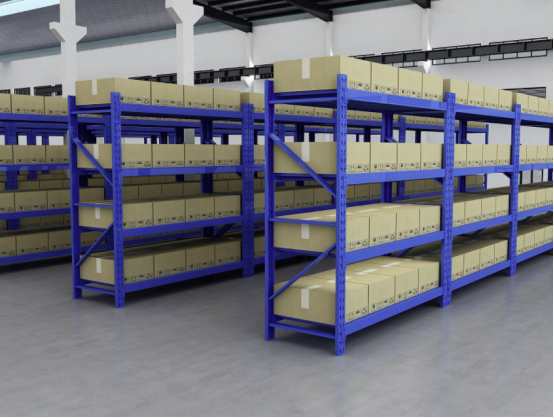
Quick answer: there is no one-size-fits-all number
A simple fixture count can be used for an early estimate, but the final quantity should be confirmed with a photometric layout or lighting simulation. A professional design considers the working areas, storage racks, aisles, loading zones, ceiling height, and local lighting requirements—not just the warehouse footprint.
How to estimate the number of fixtures
For a preliminary estimate, use the following formula:
Estimated fixture quantity = (Area x Target illuminance) / (Lumens per fixture x Utilization factor x Maintenance factor)
This formula gives an initial planning figure. The final layout may require more or fewer fixtures after considering mounting height, beam distribution, aisle geometry, obstructions, reflectance, emergency lighting, and local regulations.
The information needed for a lighting calculation
• Warehouse dimensions: length, width, and total floor area.
• Mounting height: the distance from the floor to the fixture.
• Target illuminance: the light level required for storage, picking, packing, or other tasks.
• Fixture output: the actual lumen output and wattage of the selected LED fixture.
• Layout details: racks, aisles, columns, loading areas, doors, and other obstructions.
• Operating conditions: dust, moisture, temperature, operating hours, and whether sensors or dimming are required.
Key factors when choosing warehouse lighting
1. Mounting height
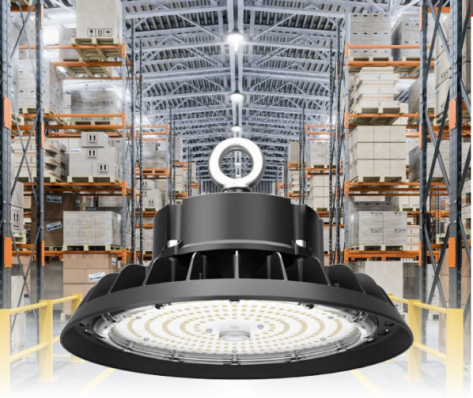
High-bay warehouses need fixtures with suitable lumen output and beam distribution. A fixture that works well at a lower ceiling may not provide enough light when installed at a greater height. LED high-bay fixtures are often selected for these applications because they offer high efficiency, long service life, and relatively simple maintenance. Romanso LED fixtures can provide efficacy above 100 lm/W, with some models reaching up to 170 lm/W, depending on the product configuration.
2. Warehouse size and layout
The same number of fixtures will not work for every warehouse. A large open storage area, narrow rack aisles, packing stations, and loading bays may require different light distributions. Romanso high-bay fixtures are available with 60°, 90°, and 120° beam angles to support different mounting heights and layout requirements.
3. Energy efficiency and lighting controls
LED lighting can reduce energy consumption and maintenance costs over the operating life of a warehouse. In some projects, a 100W LED fixture may replace a traditional 400W HID fixture, but the replacement should always be confirmed through a photometric comparison rather than wattage alone. Motion sensors, daylight harvesting, and dimming can further reduce energy use in areas that are not continuously occupied.
4. Service life and maintenance
When fixtures are installed at a high ceiling, replacement and maintenance can be time-consuming and costly. Choosing durable LED fixtures with a long rated life can reduce service interruptions. Romanso LED fixtures offer a rated lifespan of up to 50,000 hours and a 5-year warranty, subject to the applicable product terms.
5. Color temperature and visual comfort
Color temperature affects visual comfort and the appearance of the working environment. A neutral or cool-white light is commonly considered for warehouses because it supports visibility and task recognition. Romanso fixtures can be configured across a 2700K–6500K range, while the most suitable setting should be selected according to the work being performed, employee comfort, and project requirements.
6. Protection against dust and moisture
Warehouses may be exposed to dust, humidity, water spray, or temperature changes. Select a fixture with an ingress protection rating that matches the environment. Romanso LED high-bay fixtures are available with IP65 protection for suitable warehouse applications; the required rating should still be checked against the actual site conditions and local requirements.
Warehouse layout and installation considerations
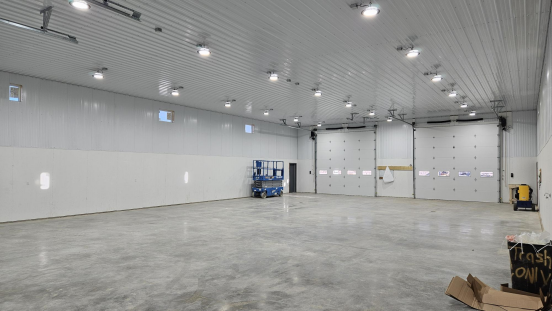
A good fixture count is only part of the solution. Fixtures should be positioned to provide uniform illumination across aisles, storage areas, workstations, and loading zones. Avoid excessive glare, dark spots, and light blocked by racks or structural elements. Fixture spacing, clearance from stored goods, emergency lighting, and fire-safety requirements must follow the applicable local codes and the fixture manufacturer’s installation instructions.
For racked warehouses, the layout should be reviewed together with the rack arrangement. A beam angle that works for an open floor may create uneven lighting in narrow aisles. The design should also allow access for inspection and maintenance without interfering with normal warehouse operations.
Project example
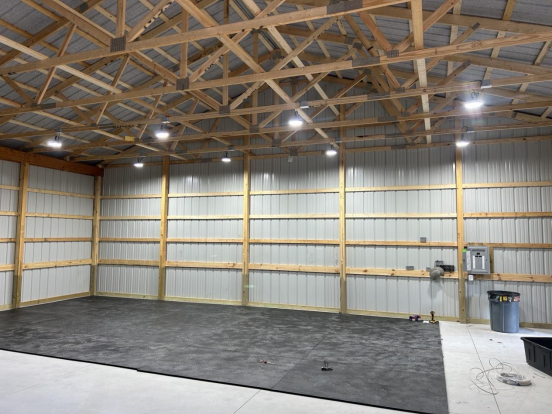
As a project reference, a warehouse measuring 80 meters long, 60 meters wide, and 10 meters high may use 240W LED fixtures, with an initial plan of 150 fixtures. This figure is an example rather than a universal rule. The final quantity and installation positions should be confirmed through a lighting simulation based on the actual fixture lumen output, beam angle, rack layout, target illuminance, and local requirements.
Romanso warehouse lighting solutions
Romanso specializes in LED industrial and outdoor lighting and has more than 19 years of experience. Our UFO high-bay lighting range is available in 100W, 150W, 200W, 240W, 300W, 400W, and 500W options. We support OEM and ODM projects, including customized labels, color boxes, and cartons.
To calculate the right number of fixtures for your warehouse, send us the building length, width, mounting height, rack or aisle layout, and intended application. Our engineers can help prepare a lighting simulation and recommend the fixture quantity, wattage, beam angle, and installation positions for your project.
Conclusion
The correct warehouse lighting design balances illuminance, uniformity, visual comfort, energy efficiency, service life, and environmental protection. Instead of choosing a fixture count based only on floor area, start with the warehouse dimensions and operating requirements, then confirm the design with a photometric calculation. This approach helps ensure reliable lighting performance and avoids over-lighting or under-lighting the facility.
Contact Romanso if you need help selecting LED high-bay lighting or calculating the lighting requirements for your warehouse.


