
 EN
 AR
 BG
 HR
 CS
 DA
 NL
 FI
 FR
 DE
 EL
 HI
 IT
 JA
 KO
 NO
 PL
 PT
 RO
 RU
 ES
 SV
 CA
 TL
 IW
 ID
 LV
 LT
 SK
 SL
 UK
 ET
 GL
 HU
 MT
 TH
 TR
 FA
 MS
 GA
The Importance of Anti-Glare Sports Lighting
2026
What’s the worst thing that can happen during a game? It’s not an opponent’s powerful smash, but rather that split second when you look up to track a high ball—only to have a row of exposed LED bulbs shine directly into your eyes. Your vision goes white, you lose sight of the ball, and it takes several seconds for your eyes to recover. This is the culprit: glare.
Many people choose sports lighting based solely on brightness, overlooking whether that light is actually comfortable. A fixture lacking anti-glare design—no matter how high its wattage—is a disaster. With exposed bulbs and direct, unshielded light, players are forced to constantly look up, causing their eyes to rapidly shift between light and dark. This leads to compounded eye fatigue and slower reaction times. Even more insidious is the fact that glare-induced damage is cumulative; while you might be able to "tough it out" for a match or two, long-term exposure is detrimental to your vision.
So, how do you create an "anti-glare" sports light? The key lies in either concealing or softening the harsh, piercing light. From an installation perspective, the goal is to ensure that light doesn't spill into areas where it shouldn't be. Both aspects are essential—if you have a well-designed fixture but install it incorrectly, the anti-glare protection becomes completely ineffective.
1. Optical Design of lamp: Controlling Brightness and Light Emission Direction at the Source
(1) Light-Shielding Structures (Anti-Glare Grilles / Deep Cavities / Visors)
This is the most direct method for glare control. The principle is simple: prevent the naked light source from being visible to the human eye. Anti-glare grilles restrict the light emission angle, ensuring that the light source (LED chips) remains out of the direct line of sight. Deep-cavity designs operate on the same logic—recessing the light source deep within a housing so that the cavity walls block direct light emitted at wide angles. Some sports lighting fixtures also incorporate visors or louvers to obstruct harmful light directed toward specific areas. The key to superior performance lies in ensuring that the depth and angle of the grilles or visors are precisely matched to the light-emitting surface of the LED chips, rather than simply adding a generic honeycomb mesh.
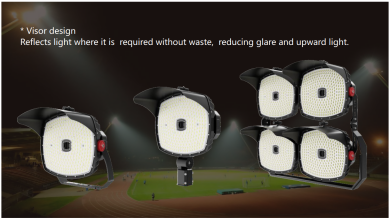
(2) Reflectors and Light Distribution Design
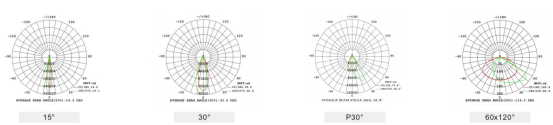
The shape of a reflector determines the path of the light. A well-designed reflector directs light precisely onto the playing field, preventing it from spilling into the sky or toward the spectator stands. Some patented designs utilize tilted, polarized reflective apertures combined with curved reflective surfaces; this approach maintains high vertical illuminance while effectively minimizing glare. Another approach involves segmented reflectors, which redistribute light through multiple reflective facets, thereby reducing high-angle light that might otherwise shine directly into people's eyes. The key to superior performance is the precise alignment of the reflector’s curvature with the position of the light source, ensuring that stray light is "captured" and redirected back toward the field.
(3) Lenses and Diffusion Treatments
Beyond shaping the light distribution, lenses can also "soften" the light source. Lenses with a frosted or etched finish diffuse the light from point sources, lowering the peak luminance of the emitting surface and, consequently, reducing the perception of glare. Research indicates that glare ratings deteriorate significantly when the average luminance of the light-emitting surface exceeds 10,000 cd/m²; therefore, reducing surface luminance is critical. The key to superior performance is achieving a balance: diffusion should not come at the expense of luminous efficiency—a high-quality lens effectively reconciles light transmission with the desired softening effect.
2.Installation and Aiming: Keeping the Light Out of People’s Line of Sight
(1)Mounting Height
Mounting height is one of the most critical factors in limiting glare. The higher the lights are installed, the steeper the angle of incidence at which light reaches the human eye, thereby reducing the likelihood of direct glare. For the exact same lighting fixture, the experience of glare can differ drastically depending on whether it is mounted on a low pole or a high mast. The key to a better outcome: whenever structural and budgetary constraints allow, prioritize increasing the mounting height rather than simply lowering the power output to compensate.
(2)Aiming Angles and Luminaire Placement
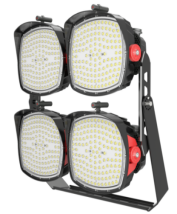
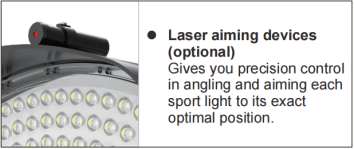
The aiming angle determines where the light beam is directed. If a light is aimed directly into the line of sight of a player looking up at the ball, even the best anti-glare louvers will be ineffective. A better approach is to orient the light beams perpendicular to the players' primary lines of sight, or to position the lights along the sides of the court rather than at the ends. For sports like tennis or badminton, which frequently require players to look upward, side-mounted lighting is far more comfortable than direct overhead lighting. The key to a better outcome: before finalizing the layout, identify where players are most likely to look upward, and ensure the lights are positioned to avoid those lines of sight.
(3)Ambient Brightness Ratio
This is a practical yet often overlooked factor. If the background—such as a ceiling or the night sky—is very dark while the lights are intense, the human eye becomes significantly more sensitive to glare due to the sharp contrast. Conversely, increasing the ambient brightness to reduce the contrast between the light source and its background will help mitigate the perception of glare. This is especially true in indoor sports facilities: if the ceiling is too dark, looking up toward the lights becomes particularly blinding. The key to a better outcome: for indoor facilities, consider using indirect lighting or materials with diffuse reflection to increase the brightness of the overhead environment, rather than focusing solely on the lighting fixtures themselves.
Anti-glare is never just a bullet point on a spec sheet; it is the essential, underlying standard that defines the quality of the playing experience. When selecting sports lighting, it is worth asking a few key questions: Are the louvers deep enough? Do the lenses provide a soft, diffused light? Are the mounting height and angle correctly configured? By concealing the light source and precisely controlling the beam direction—ensuring that players see only the ball, not the glare of the lamps—you achieve the true standard for sports facility lighting.


