
 EN
 AR
 BG
 HR
 CS
 DA
 NL
 FI
 FR
 DE
 EL
 HI
 IT
 JA
 KO
 NO
 PL
 PT
 RO
 RU
 ES
 SV
 CA
 TL
 IW
 ID
 LV
 LT
 SK
 SL
 UK
 ET
 GL
 HU
 MT
 TH
 TR
 FA
 MS
 GA
Choosing UL 844 LED Explosion Proof Lighting for Industrial Facilities
2026
At a chemical plant, a lighting upgrade begins with understanding what surrounds the fixture. Flammable vapor, airborne dust, elevated temperatures and difficult maintenance access can all affect the decision. Buyers need dependable visibility, but they also need equipment whose certification matches the installation.
ROMANSO's 2025 RMS-H2502 LED explosion-proof light brings these considerations together through UL 844 certification, multiple optical distributions and a choice of power ratings. This guide explains where hazardous location lighting is used, how certification affects selection, and what current market developments mean for industrial lighting projects.
Where hazardous location lighting is needed
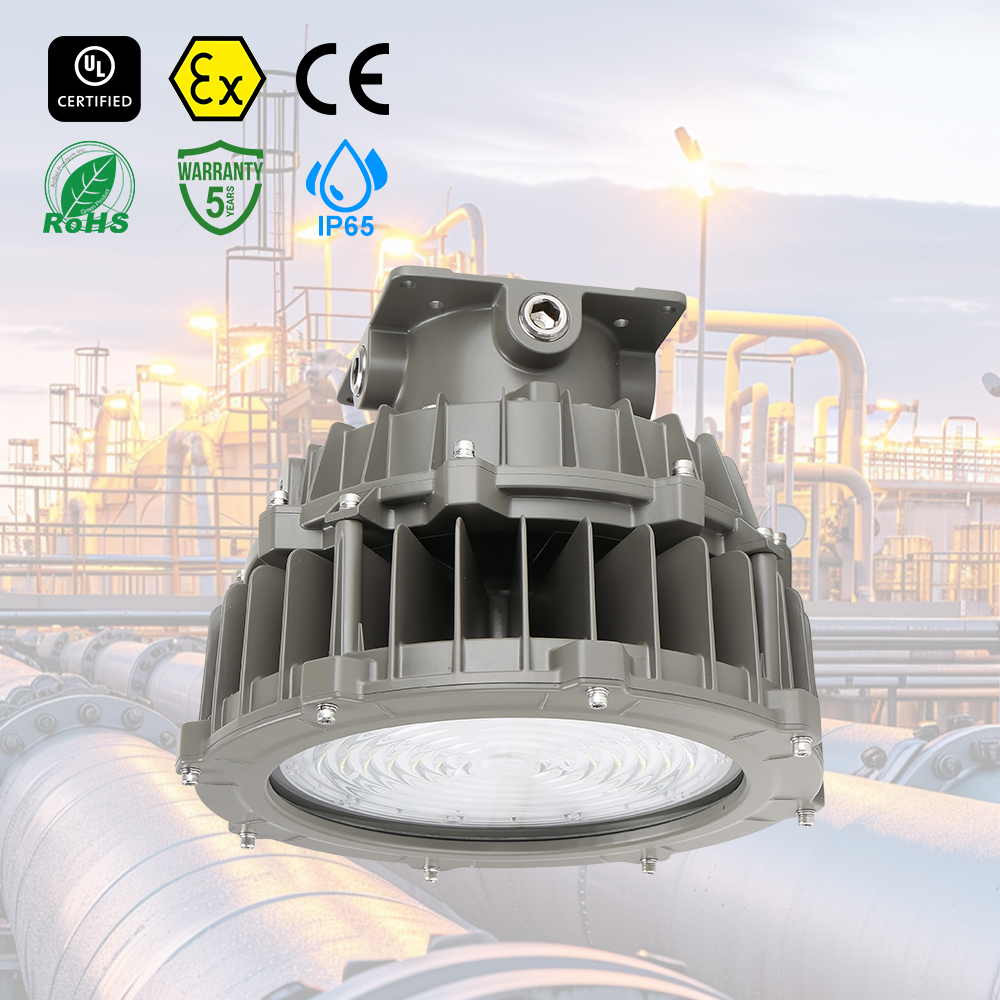
Oil and gas operations are familiar applications, including designated areas around processing equipment, storage installations and loading facilities. Here, lighting helps personnel identify valves, inspect equipment and navigate access routes. The relevant hazard classification must be established for each location; an entire facility does not necessarily share one classification.
Chemical manufacturing and solvent handling introduce similar questions. A luminaire near a mixing process may face different requirements from one in an adjacent service corridor. Buyers should establish whether the hazard involves gas, vapor, dust or fibers before discussing wattage and mounting accessories.
Combustible dust also makes hazardous location lighting relevant to selected areas in grain processing, flour production and other material handling operations. These applications require the appropriate dust approval. A gas-rated fixture cannot be assumed suitable simply because its enclosure appears robust.
For the RMS-H2502, application suitability should be confirmed against the exact model's certification record, nameplate and installation instructions. Industry examples provide a starting point for discussion; the approved classification determines where a particular configuration can be installed.
A useful project brief also describes the work being performed. Reading a small instrument display, checking a pipe connection and moving materials through an aisle place different demands on light distribution. Photographs and detailed layout drawings help explain these differences. They also reveal obstructions that a floor-area measurement alone may miss, such as overhead pipework, storage racks or closely spaced process equipment.
Understanding UL 844 and international requirements
UL 844 addresses luminaires intended for hazardous classified locations under the US National Electrical Code framework. Its scope includes different gas, dust and fiber classifications, but certification of an individual product covers only its approved ratings. Buyers should verify the Class, Division or Zone, material group, temperature marking and permitted ambient conditions. [1]
The RMS-H2502 specification identifies UL 844 certification and also references UL 1598 for ordinary locations. These designations serve different purposes. UL 1598 alone does not establish suitability for an explosive atmosphere, and a general UL 844 statement does not establish approval for every hazardous area.
For EU projects, equipment within the scope of ATEX Directive 2014/34/EU must follow the applicable conformity assessment requirements before entering the market. The required route depends on the equipment category and other relevant characteristics. [2]
IECEx provides an international certification system based on IEC standards. Its equipment certificates can support market access, although national requirements may still apply. UL 844, ATEX and IECEx are separate frameworks: holding one does not automatically establish compliance with the others. [3]
The RMS-H2502 should therefore be specified using its documented UL certification scope. Projects requesting ATEX or IECEx need separate evidence for the offered model. Likewise, IP65 ingress protection and IK08 impact resistance describe environmental performance; they do not replace hazardous location approval.
What the RMS-H2502 offers project buyers
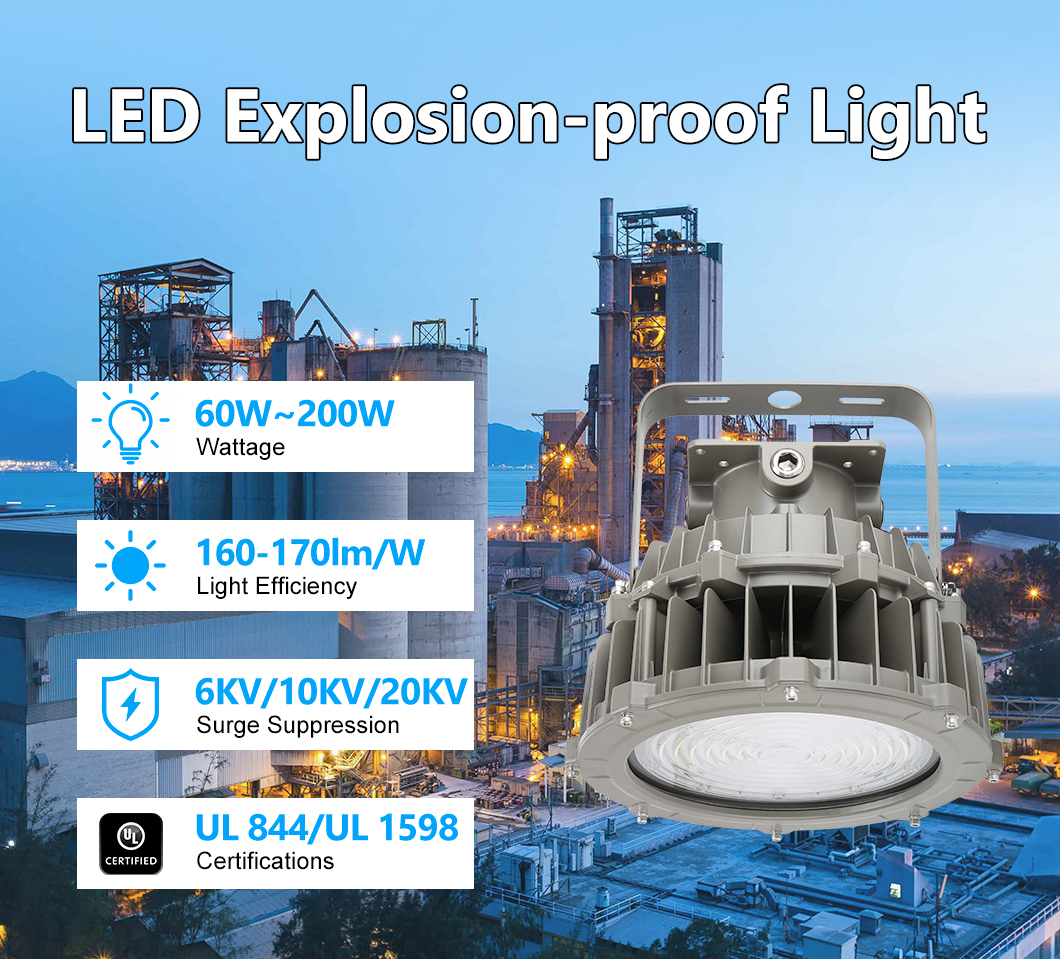
The RMS-H2502 series covers 60W to 200W, with 120–277V and 347–480V supply options. Its performance table includes 3000K, 4000K and 5000K configurations with a listed CRI of 70. These choices allow buyers to discuss both the electrical supply and the visual needs of the work area.
Output varies with configuration. At 4000K or 5000K, the table lists 10,500 lumens for 60W, 20,500 lumens for 120W and 31,500 lumens for 200W. The corresponding efficacy figures are 175, 171 and 158 lm/W. Comparing these specific values is more useful than applying one headline efficacy to the entire range.
Beam choices of 60°, 90° and 120° provide flexibility when planning coverage. A narrower distribution may help direct light from higher mounting positions, while broader optics may suit wider coverage at lower heights. Final selection should follow a lighting calculation that considers working-plane illuminance, obstructions, uniformity and glare.
The fixture combines a low-copper cast aluminum housing with a finned heat-dissipation structure. The specification lists IP65, IK08 and an operating temperature range of −40°C to +65°C. Project teams should check the selected configuration's approved temperature limits and mounting conditions before ordering.
A trunnion bracket is standard, with ceiling, pendant, wall and round-pole mounting options. Optional 0–10V/PWM/Rx dimming supports projects requiring adjustable output. ROMANSO also specifies a five-year warranty, giving buyers a defined warranty period to consider alongside installation and maintenance costs.
When comparing quotations, keep the configuration consistent. A different voltage version, beam angle or mounting accessory can change what is being supplied. Ask suppliers to identify the complete ordering configuration and the documents that apply to it. During evaluation, record the existing light levels and intended operating schedule so the proposed improvement has a measurable baseline. This makes technical comparisons easier for procurement staff and gives engineers clearer information for their final review.
Market conditions and purchasing priorities
Hazardous location LED lighting serves both new industrial construction and replacement projects. In its current market outlook, IMARC estimates global revenue of USD 531.56 million in 2025 and projects USD 847.54 million by 2034, with a stated 4.88% CAGR for 2026–2034. These are research estimates for hazardous location LED lighting, rather than audited sales totals for every explosion-proof lighting category. [4]
IMARC identifies industrial modernization, safety compliance and replacement of older lighting as demand drivers. For buyers, the practical implication is to evaluate operating costs and approval requirements together. An attractive purchase price has limited value if the proposed fixture creates documentation problems or cannot deliver the required illumination. [4]
Our purchasing recommendation is to compare proposals at the project level. Include fixture quantity, installation labor, operating hours and access requirements. For an illustrative replacement, reducing measured lighting load from 250W to 150W over 4,000 annual operating hours saves 400 kWh per fixture each year. That calculation assumes equivalent lighting performance has already been verified; it is not a guaranteed RMS-H2502 replacement ratio.
Future opportunities for hazardous location lighting
We expect future purchasing decisions to give greater attention to usable light per watt, service access and the quality of supporting documentation. Higher efficacy is valuable when the optical design also places sufficient light on the task. Clear configuration records can make later replacement and maintenance decisions easier.
Controls offer another development opportunity. IMARC highlights connected monitoring and automated lighting management as market trends. In hazardous locations, any proposed controls must remain compatible with the approved installation. The RMS-H2502 currently lists optional dimming; wireless monitoring and predictive maintenance should be treated as wider industry developments, not included product functions. [4]
For manufacturers, these developments suggest an opportunity to pair efficient luminaires with clearer application support. For owners, the priority remains a lighting system that fits the site's hazards and daily work, with performance that can be checked throughout its service life.
Discuss your project with ROMANSO
Planning a hazardous location lighting upgrade? Share your project country, area classification, supply voltage, mounting height and target illuminance with ROMANSO. We can use these details to discuss the appropriate RMS-H2502 configuration and the supporting documentation needed for your evaluation. Starting with the site requirements helps turn a product comparison into a practical lighting proposal.


